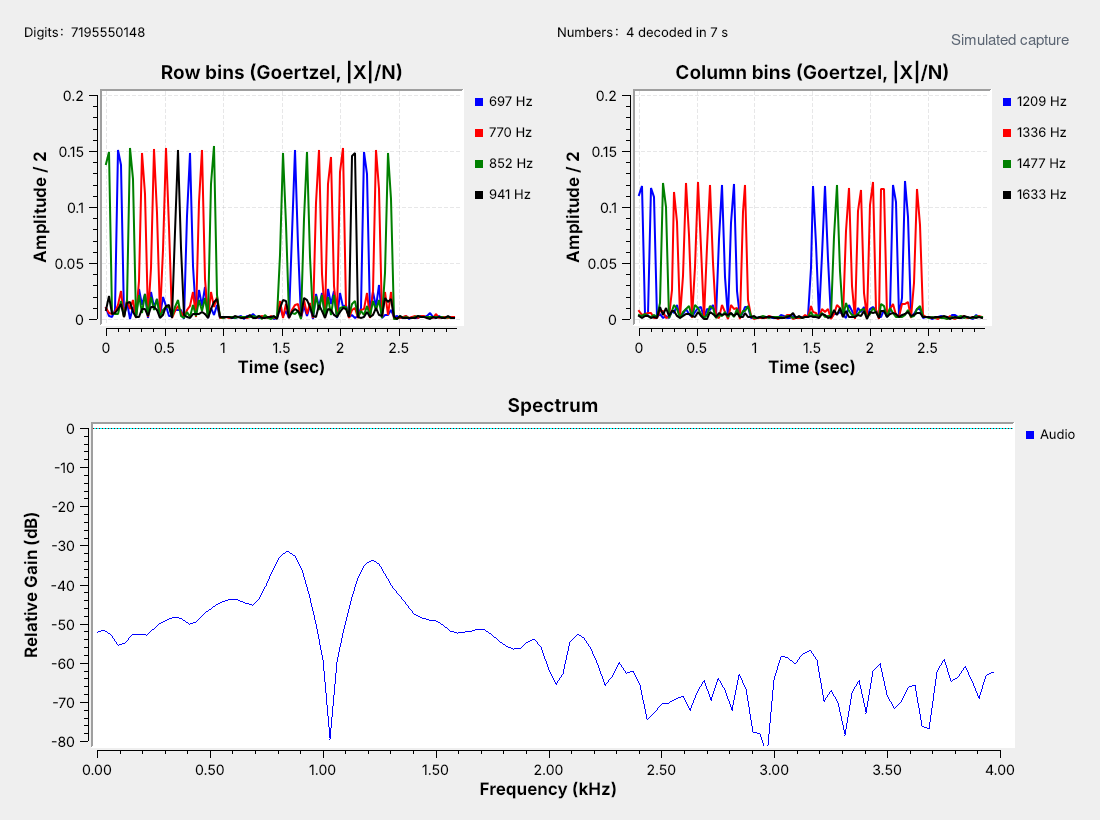
 Each digit raises one row bin and one column bin. The capture is simulated.
Note:
Run L13-dtmf-rx.grc live. The capture is synthetic: L13-dtmf-capture.grc dialed it with 50 ms tones and gaps, -2 dB of twist, and 20 dB SNR. Row peaks reach 0.15, half the 0.3 amplitude; column peaks 0.12.
---
## The Keypad Grid
'5' sends 770 Hz and 1336 Hz.
Note:
The frequencies are chosen so that no tone's harmonics land on another tone. The closest pair is 697 and 770 Hz, 73 Hz apart. The A to D column set call precedence on AUTOVON and carries control codes on radio systems.
---
## One Key in GNU Radio
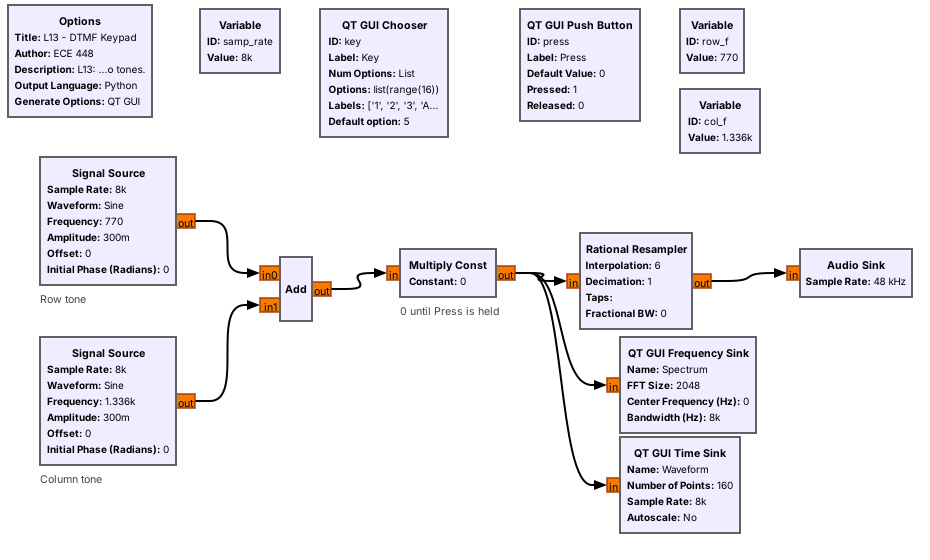 `row_f` = `[697, 770, 852, 941][key // 4]` · `col_f` = `[1209, 1336, 1477, 1633][key % 4]`
Note:
Two float Signal Sources at amplitude 0.3, an Add, and a Multiply Const by the Press button. Everything runs at 8 kHz; a Rational Resampler raises it by 6 to 48 kHz for the Audio Sink, because not every laptop sound card accepts 8 kHz.
---
## Two Tones, One Key
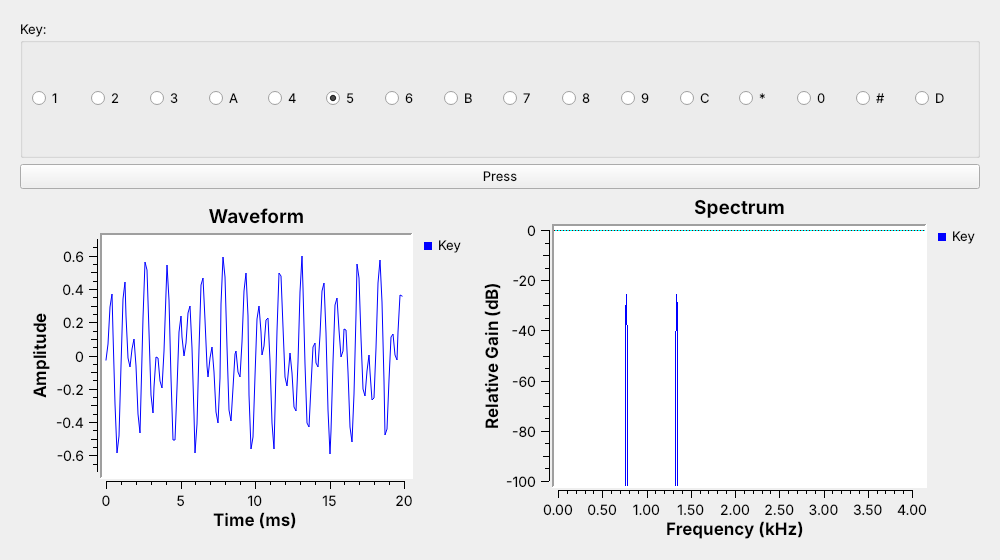 In time the tones beat; in frequency they separate.
Note:
Run it and hold Press. The receiver works in frequency because the digit is obvious there.
---
## Timing and Twist
- Tones last 40 ms or longer.
- Gaps between digits last 20 ms or longer.
- The column tone may arrive a few dB weaker: **twist**.
Note:
Auto-dialers typically send 50 ms on and 50 ms off, 10 digits a second. A receiver ignores bursts much shorter than a tone, which keeps speech from looking like a digit. Lines lose more at high frequencies, so the column tone often arrives weaker; the link has a twist slider.
---
## The Capture
The simulated capture uses 50 ms tones and gaps, −2 dB twist, and 20 dB SNR.
Note:
L13-dtmf-capture.grc chains the DTMF Dialer Embedded Python Block, a Noise Source, a Head, and a Wav File Sink. It writes one dialing and a 500 ms pause, 1.5 s at 8 kHz. The three 5s are separate because a gap separates them.
---
## Ready-Made Decoders
- `multimon-ng -t wav -a DTMF L13-capture.wav` prints the ten digits.
- An Android DTMF app hears them through the microphone.
- How else could we decode it?
Note:
From the 2025 deck: the transmitter is easy, the decoder not so easy. Run multimon-ng (Linux: apt install multimon-ng sox; macOS: brew install multimon-ng sox; Windows: inside WSL2) on L13-capture.wav to show the digits, or play the file to a phone app, then ask how we would build the decoder ourselves.
---
## Separating Neighboring Tones
- Eight band-pass filters, each followed by an energy detector
- Each must reject a neighbor 73 Hz away
- A narrower filter has to listen longer
Note:
A 40 ms tone leaves room for a block of about 25 ms, with margin for the tone's start and end.
---
## The Goertzel Block
| Parameter | Setting |
| :-- | :-- |
| Sample rate | 8000 |
| Length | 205 |
| Frequency | one DTMF tone |
205 samples at 8 kHz last 25.6 ms: bins 39 Hz apart, nulls 39 Hz either side.
Note:
The Goertzel algorithm measures the energy at one frequency over a block, far cheaper than an FFT when only eight frequencies matter. GNU Radio has it as a stock block. 205/8000 = 25.6 ms fits in a 40 ms tone; 8000/205 = 39 Hz.
---
## Bins Against Tone Spacing
Bins 39 Hz apart, nulls 39 Hz either side; each neighbor lands far down.
Note:
Each bin is a band-pass filter read once per block. A longer block narrows the bins but outlasts a short tone; a shorter one widens them. The lab changes N and watches both.
---
## The Receiver
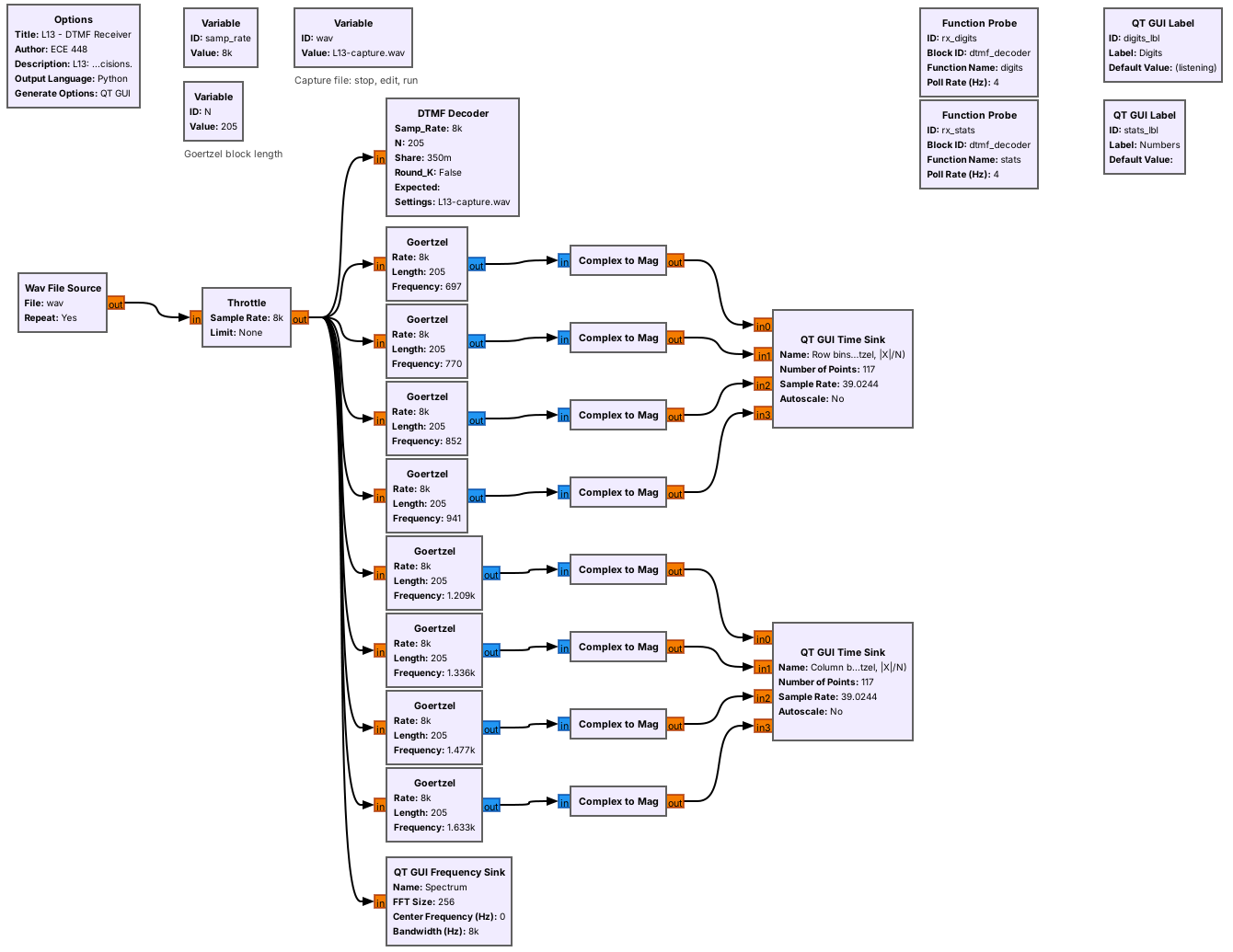 Stock **Goertzel** blocks show the bins; the **DTMF Decoder** decides.
Note:
Each stock Goertzel block outputs the bin divided by N once per block; Complex to Mag shows half the tone's amplitude. The DTMF Decoder runs its own eight bins on a 205-sample block every 102 samples.
---
## The Decision Rules
1. Best row and column bins hold 35% of the block's energy.
2. Each beats its group's other bins by 6 dB.
3. Twist is within −10 to +6 dB.
4. Three blocks in a row agree.
Note:
Test 1 rejects noise and speech, test 2 a second tone in a group, test 3 a pair whose levels differ too much. The blocks start 102 samples apart, so a tone must outlast about one 25.6 ms block, which rejects short bursts. A block without the digit must come before it counts again, so 555 reads as three digits.
---
## DTMF Explorer
- Lower the SNR: "too little energy."
- Move the frequency error until the tone slides off its bin.
- Lower N until the main lobes overlap.
↗ Interactive on the lesson page
Note: Start at key 5, N 205, 20 dB. Raise twist past +6 dB to show test 3. The explorer tests one block; the flowgraph needs three. --- ## Add Noise Until Digits Drop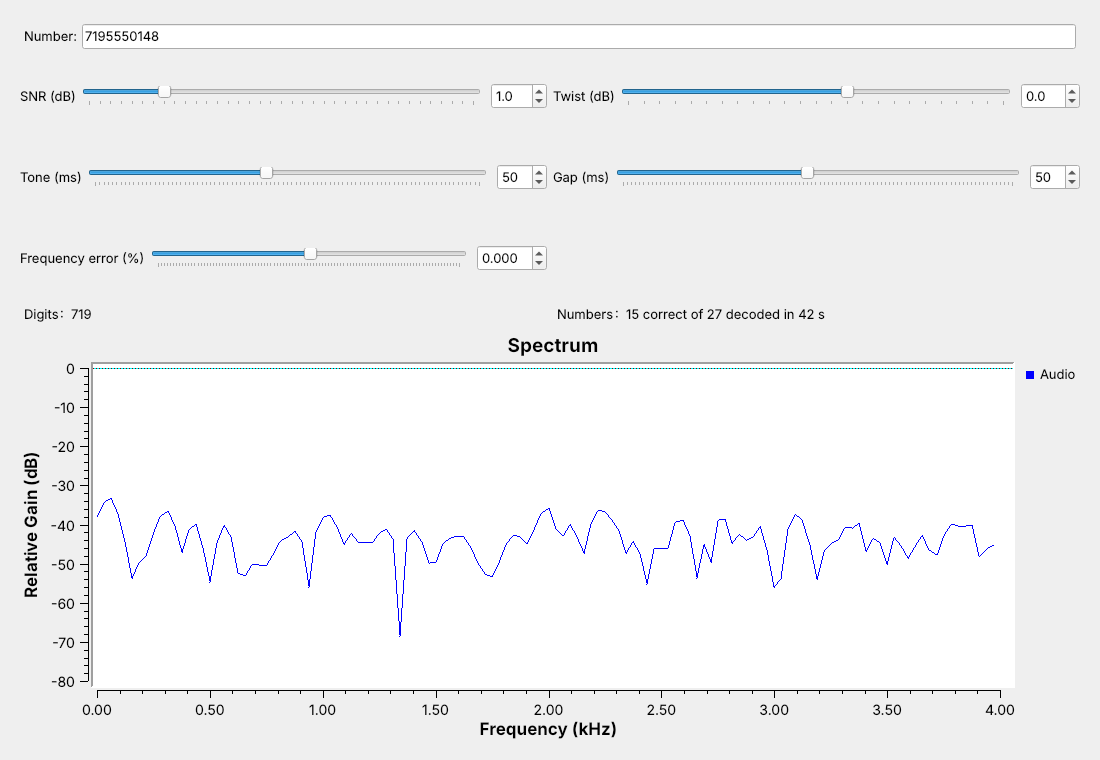 Every number arrives to about 2 dB; some drop near 1 dB; almost none at 0 dB.
Note:
Run the link live and pull the SNR slider down. With bins 39 Hz apart, nulls 39 Hz either side, each bin sees only a small slice of the noise. Ten minutes of noise alone produced no false digits. With no noise, every key decodes at 1.5% frequency error and none at 2%.
---
## DTMF on a Real Radio
- Repeaters and remote sites take DTMF over FM.
- L13-nfm-pluto.grc: narrow FM on the PlutoSDR.
- Its 8 kHz audio feeds the same DTMF Decoder.
- The L13 Lab decodes a phone through the laptop microphone.
Note:
Nothing in this lesson transmits. In class we transmit only into a cable, into a shielded enclosure, or at very low power in an ISM band, and only when the lesson says to.
L13-nfm-pluto.grc: type a channel that carries DTMF (a local 2 m repeater output) into Channel. Course Plutos run in extended-frequency mode, 70 MHz to 6 GHz. The Pluto tunes 200 kHz low at 1.536 MS/s with slow-attack AGC; the Xlating filter brings the channel to 48 kHz, and NBFM Receive (5 kHz deviation) decimates the audio by 6 to 8 kHz. Compiled, not yet run on a live channel. Optional: multimon-ng prints the digits from a recording: sox L13-capture.wav -t raw -e signed-integer -b 16 -r 22050 -c 1 - | multimon-ng -t raw -a DTMF -
Tutorials this lesson follows: GNU Radio wiki Embedded Python Block, Goertzel, Signal Source, and Wav File Source pages; multimon-ng is the deck's ready-made decoder.
---
## Key Point